Family Residency · Dependent Visas · Sponsorship · UAE 2026
The question most UAE residents have never asked — and the one with the most consequential answer. Your family's right to remain in the UAE depends entirely on what happens to yours.
Dependent residency in the UAE is not an independent status. It is an extension of the primary sponsor's residency — legally contingent, administratively linked, and subject to the same ICP system that governs the sponsor's own visa. Understanding this dependency is not merely a legal formality for families living in the UAE. It is the difference between an orderly response to an unexpected change and a rushed, costly, and disruptive exit that no family should have to navigate unprepared.
This article addresses the scenarios that matter most to families: what happens when the primary visa lapses, when the sponsor's employment or circumstances change, and — in the most difficult of circumstances — when the primary holder passes away. For each scenario, the legal position is explained, the options available are set out, and the steps that should be taken immediately are stated plainly.
When a UAE resident sponsors a family member for residency, that family member's visa is issued as a dependent permit — a document that exists because the sponsor's visa exists. The two are linked in the ICP system through the sponsor's Unified Identification Number. Any change to the primary visa status is automatically and immediately reflected in the dependent's file.
Under standard UAE residence visa sponsorship, the sponsor is required to maintain a minimum income of AED 4,000 per month (or AED 3,000 per month plus accommodation) to qualify for family sponsorship. Beyond the financial threshold, the sponsor must maintain an active, valid residence visa — because the moment that visa is cancelled or expires, the legal basis for every dependent visa issued under it is simultaneously removed. There is no buffer, no warning, and no administrative courtesy period. The cancellation is automatic.
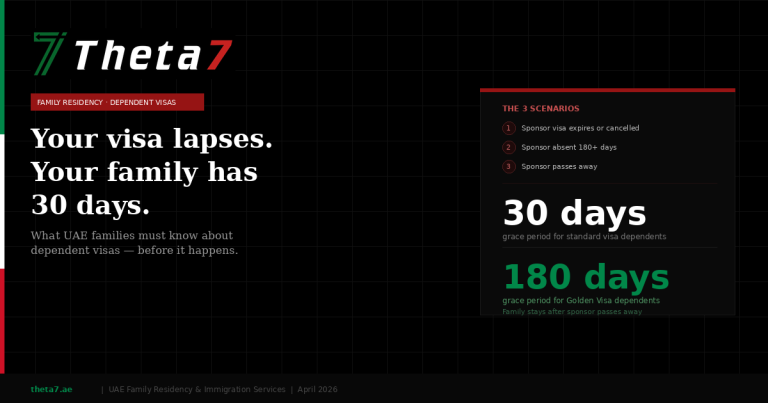
When a standard residence visa sponsor's visa is cancelled or expires — whether due to overstay, a lapsed trade license, employer action, or voluntary cancellation — all dependent visas issued under that sponsorship are cancelled simultaneously. Dependent family members are given a grace period of approximately 30 days within which they must either transfer to a new sponsor, apply for an alternative visa category, or exit the UAE. The 30-day period begins from the date of the primary visa cancellation — not from when the family becomes aware of it. Days lost to unawareness are days lost from the grace period.
If the primary sponsor's visa is automatically cancelled due to the 180-day absence rule — which occurs without any notification from ICP — the dependent visas are cancelled at the same moment. Families may be entirely unaware that the cancellation has occurred until they attempt to use their Emirates IDs, access government services, or return to the UAE from travel abroad. The 30-day grace period is calculated from the cancellation date, not from when the family discovers it. A family that discovers the cancellation on day 20 has only 10 days remaining. The absence rule is the most common trigger of unintended dependent visa cancellations — because it is the one the sponsor never sees coming.
Under standard UAE residence visa sponsorship, the death of the primary holder results in the immediate cancellation of all dependent visas. The family enters the same 30-day exit or transfer window that applies in every other cancellation scenario — regardless of the circumstances, the emotional reality of that period, or how long the family has lived in the UAE. Under Golden Visa sponsorship, this provision does not apply. If the primary Golden Visa holder passes away, sponsored family members are permitted to remain in the UAE until the expiry date of their own individual residence permits. They are not forced to exit, transfer sponsorship, or take any immediate action. This provision has no equivalent under standard visa sponsorship and is one of the least discussed — and most important — differences between the two frameworks.
If you are a dependent whose sponsor's visa has been cancelled or has expired, the priority is not to wait for clarification, reassurance, or a formal notification that never comes. The priority is to act immediately within the grace period. The 30-day window is not an opportunity for deliberation. It is a hard deadline, and every day that passes without action reduces the number of options available at the end of it.
Contact a licensed UAE immigration advisor within the first 48 hours of becoming aware of the cancellation. The options available — alternative sponsorship, self-sponsored visa categories, new employer visa, the UAE Green Visa for qualifying professionals — all require time to process. The earlier you engage, the broader your choices. A firm such as Theta7 can assess your situation same-day and advise on the fastest available resolution pathway.
The specific options within the 30-day window depend entirely on individual circumstances. If the dependent is employed, a new employer visa or an independent work permit may be the most direct route. If they qualify for a self-sponsored category — the UAE Green Visa is available for graduates, skilled employees, and freelancers meeting certain criteria — that pathway may allow them to remain in the UAE without needing a sponsor at all. If neither applies immediately, exiting the UAE temporarily and re-entering on a new visa once alternative sponsorship is arranged is a structured and entirely legitimate option.
None of these routes can be assessed properly without a full picture of the individual's circumstances. Which is precisely why professional guidance in the first 24 to 48 hours is not a luxury — it is a practical necessity when time is the binding constraint.
A primary sponsor whose renewal is managed proactively does not create a dependent visa crisis. A resident who monitors their 180-day absence threshold does not trigger a silent cancellation that leaves their family without valid residency. A business owner who maintains their trade license in good standing does not undermine the visa issued under it. The common thread across all three scenarios is not bad luck. It is the absence of structured, proactive management of a set of documents with known expiry dates and known consequences.
For residents with families in the UAE — particularly those with children in school, spouses who are not independently employed, or elderly parents living in the country on dependent visas — the case for proactive management is not abstract. It is the most concrete protection available for the people who depend most on the primary visa holder's residency remaining intact.
For residents with families, the Golden Visa represents a categorically higher level of legal security. The 180-day absence exemption means a parent travelling for work cannot accidentally cancel their family's residency. The 180-day grace period means an unexpected job loss does not immediately endanger the family's right to remain. The death provision means a spouse and children are not forced out of the country in their most vulnerable moment. If you have a family in the UAE and are on a standard residence visa, assessing your Golden Visa eligibility is one of the most practical steps you can take today. Many UAE-based business owners and professionals qualify without knowing it.
UAE immigration is a well-structured system. Its rules are clear, its deadlines are published, and its processes — when approached with adequate preparation and the right support — are entirely manageable. What makes it costly and disruptive is not complexity. It is delay, oversight, and the assumption that things will resolve themselves administratively when they do not.
For families, the stakes of that assumption are categorically higher than for individuals. A lapsed visa is an inconvenience for a single resident. For a family with children in school, a spouse without independent sponsorship, and a life built over years in the UAE, it is something far more serious. The appropriate response to that reality is not anxiety — it is structure, forward planning, and professionals who ensure the deadlines are never missed in the first place.
1. Check the expiry dates of every visa in your household — primary and all dependents — at smartservices.icp.gov.ae. 2. If any visa is within six months of expiry, initiate renewal now. 3. If you have a family in the UAE and are on a standard visa, contact Theta7 to assess your Golden Visa eligibility — it takes a single conversation.
Theta7 provides complete UAE residency management for individuals and families — whether you are renewing existing visas, navigating an unexpected cancellation, protecting your family through a Golden Visa transition, or responding to an urgent 30-day window. We work with clients inside the UAE, overseas, and across time zones. We respond the same day.
Primary visa renewals — all UAE sponsor types, managed end to end
Dependent and family visa applications, renewals, and transfers
Golden Visa eligibility assessment and full application management
Emergency dependent visa resolution within the 30-day window
Expired and cancelled visa resolution — re-entry permits and status regularisation
Ongoing renewal monitoring for the whole household — so no deadline is ever missed
theta7.ae · UAE · Overseas · Global · Same-day response