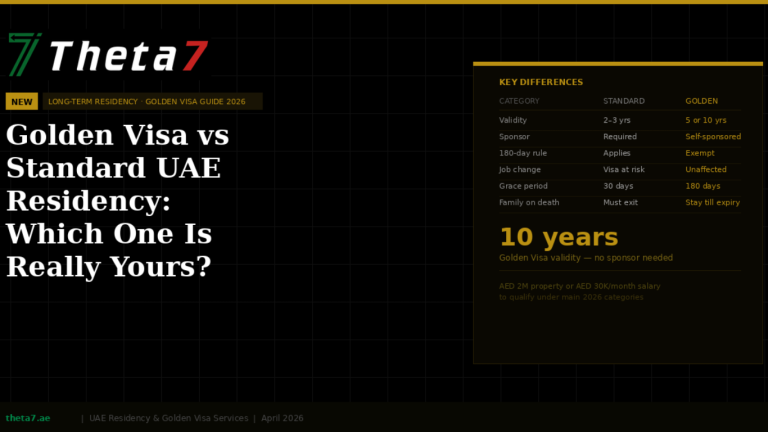
Long-Term Residency · Golden Visa · Standard Visa · Full Comparison
Two visa categories. Fundamentally different legal protections. One question every UAE expat should be asking: which one am I on — and is it still the right one for my life here?
here are two fundamentally different legal frameworks for long-term residency in the UAE. Both produce a valid residence visa. Both allow the holder to live and work in the country. Both result in an Emirates ID delivered to your registered address. Beyond those surface similarities, the legal structures, protections, limitations, and risks that each framework confers are categorically different — in ways that only become visible when circumstances change. A job ends. An employer cancels. A trip abroad runs longer than expected. A crisis closes the airspace. In each of those scenarios, which visa you hold determines everything that happens next.
This article maps those differences without ambiguity — for existing UAE residents on standard visas, for those already on a Golden Visa who want to understand their protections fully, and for those who have never seriously compared the two and are now, for any number of reasons, ready to do so.
The defining characteristic of a standard UAE residence visa is dependency. It is issued under the sponsorship of a third party — an employer, a trade license holder, or a UAE national family member. The visa's existence, its continuation, and its validity are contingent on that sponsor's active status and ongoing willingness to maintain the sponsorship relationship. When the sponsor changes, the visa must be transferred. When the sponsor cancels it — for any reason — the holder's time in the UAE becomes subject to a grace period that is measured in days, not months.
The UAE Golden Visa operates on an entirely different legal basis. It is self-sponsored. It belongs to the holder, not to any employer or business entity. It cannot be cancelled by an employer. It is not affected by a change in employment, a business closure, or the administrative status of any sponsoring organisation. The residency right is the individual's own — issued directly by ICP for a period of five or ten years — and it continues regardless of what happens to any employment or commercial relationship the holder maintains.
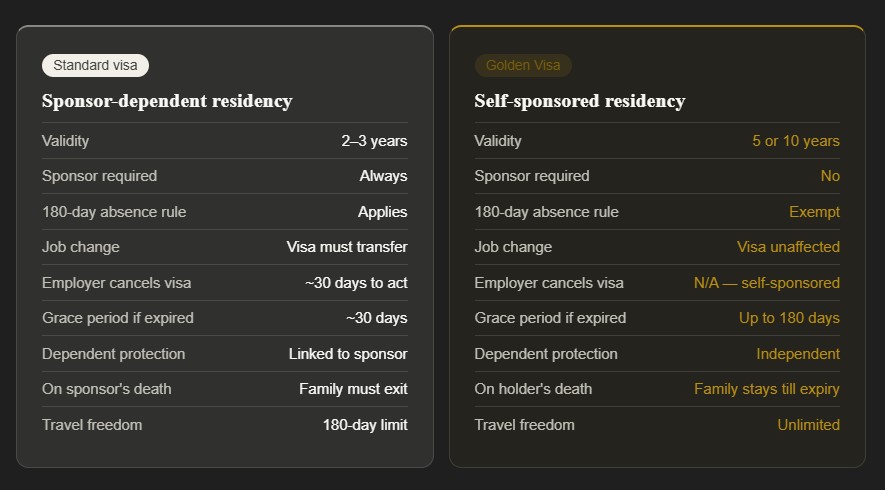
The 180-day absence rule has always been one of the most significant limitations of a standard UAE residence visa. If the holder remains outside the UAE for more than 180 consecutive days, the visa is automatically cancelled by the ICP system — without warning, without notification, and regardless of the printed expiry date. The count begins the moment the holder exits through any UAE port and resets to zero on each lawful re-entry.
For most residents, this was a theoretical risk managed by ensuring regular returns. The February 2026 regional airspace crisis made it concrete and immediate. Thousands of standard visa holders were stranded abroad by flight cancellations beyond their control, watching the 180-day threshold approach with no ability to return. ICP introduced an emergency grace period — but that measure expired on 31 March 2026. The residents who relied on it are now completing post-grace renewals under time pressure. The residents who did not return in time are navigating re-entry permit applications with accruing fines.
Golden Visa holders in the identical situation faced none of these consequences. The 180-day rule does not apply to them. Their visa continued to run against its printed expiry date regardless of how long they were abroad. The crisis produced no immigration emergency for Golden Visa holders — only for those on standard visas. That distinction, which had previously been abstract for many residents, became lived experience in the space of six weeks.
Under standard UAE residence visa sponsorship, family members' visas are issued as dependent permits — documents that exist because the sponsor's visa exists. They are linked in the ICP system to the sponsor's Unified Identification Number. Any cancellation of the primary visa cancels the dependent visas simultaneously. The family has approximately 30 days to find alternative sponsorship, transfer to an independent visa category, or exit the UAE. That 30-day clock runs from the date of cancellation — not from the date the family becomes aware of it.
Under Golden Visa sponsorship, dependent visas are issued for the same duration as the primary holder's visa and are not affected by changes in the holder's employment or business arrangements. More critically, in the event of the primary Golden Visa holder's death, sponsored family members are permitted to remain in the UAE until their own individual residence permits expire. This provision has no equivalent under standard sponsorship. Under standard rules, the death of the primary holder triggers immediate cancellation of all dependent visas and the same 30-day exit window — regardless of the circumstances, the ages of children in school, or the complexity of the moment.
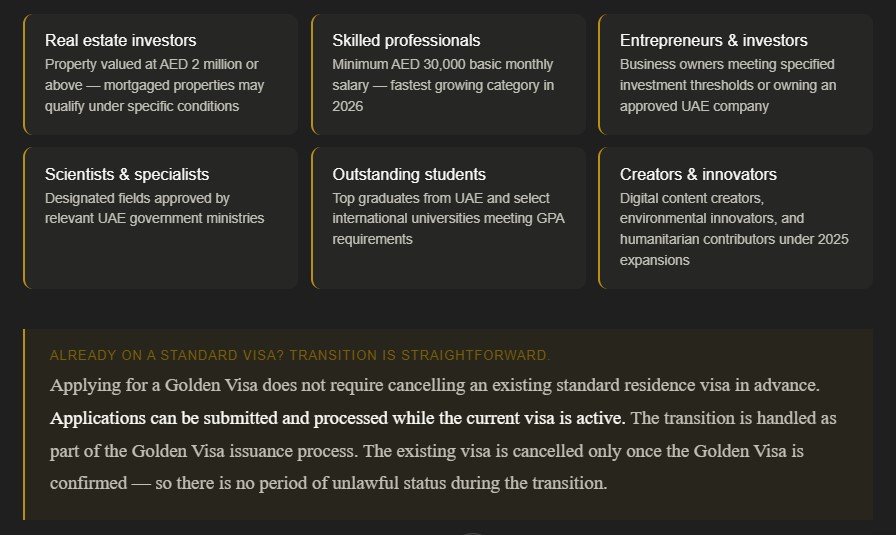
The Golden Visa programme has expanded significantly since its 2019 introduction. The 2026 eligibility categories are broader than most residents realise, and the fastest-growing application segment is salaried professionals — not property investors. Consultants report rising inquiries specifically from mid-level managers and senior professionals already holding standard work visas who qualify under the salary category but have not yet applied.
1. If your employer cancelled your visa tomorrow, would 30 days be enough time to sort your situation — and your family's?
2. If you needed to be abroad for six months, would your UAE residency survive it?
3. Do you earn AED 30,000 or above per month, own UAE property at AED 2M+, or run a qualifying UAE business? If yes to any of these — you may already qualify for the Golden Visa. The next step is finding out.
We handle the full Golden Visa process — from confirming your eligibility category to submitting the application and managing the transition from your existing visa. If you qualify, we will tell you clearly and get it moving.