UAE Regulatory Update · May 2026
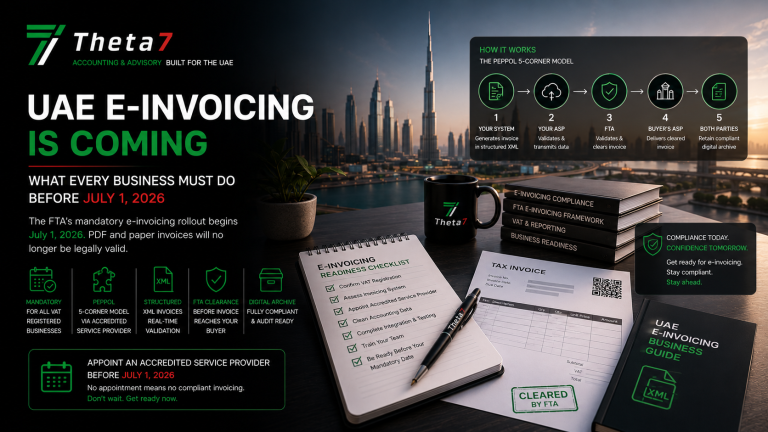
UAE E-Invoicing Is Coming — What Every Business Must Do Before July 1, 2026
The FTA's mandatory e-invoicing rollout begins in a matter of weeks. PDF and paper invoices will no longer be legally valid. Here is everything you need to know — and the steps to take right now.
If you run a VAT-registered business in the UAE, there is one compliance deadline you cannot afford to miss this year. The Federal Tax Authority's (FTA) e-invoicing pilot launches on 1 July 2026 — and the appointment of an Accredited Service Provider (ASP) must happen before that date. No appointment means no compliant invoicing. And from 2027, that translates directly into legal and financial exposure.
This is not a distant regulatory change. It is happening now. This article breaks down exactly what e-invoicing means, who it affects, when each deadline falls, and what your business needs to do before the end of June.
What Is E-Invoicing — and Why Does It Change Everything?
E-invoicing is not simply sending a PDF by email. Under the UAE's framework, it means issuing invoices in a structured XML format — a machine-readable data standard that can be validated, transmitted, and archived automatically without human re-keying.
Think of it this way: a PDF invoice is a picture of data. A structured XML invoice is the data itself. The difference matters because the FTA will receive and validate your invoice data in real time before the document ever reaches your buyer.
How the System Works: The Peppol 5-Corner Model
The UAE has adopted a framework built on Peppol — the same international e-invoicing network used across Europe, Singapore, and Australia. Understanding how it works helps clarify why the ASP appointment is not optional.
Your accounting system generates the invoiceThe invoice is created in structured XML format — not a PDF — inside your ERP or accounting software.
Your ASP validates and transmits the dataYour Accredited Service Provider receives the XML, validates it against FTA specifications, and sends it to the FTA's central platform.
The FTA validates and clears the invoiceThe tax authority processes the invoice in near-real time and returns a clearance status.
The cleared invoice reaches your buyerOnly after FTA clearance is the invoice formally delivered to the buyer's system via their own ASP.
Both parties retain a compliant digital archiveThe entire process is logged and archived in a format that satisfies FTA audit requirements.
The UAE has adopted the "5-corner" Peppol model, meaning both sender and receiver must have registered ASPs. You cannot simply send an XML file directly to your customer — the infrastructure on both ends must be in place.
Who Needs to Act Right Now?
Every VAT-registered business in the UAE needs to appoint an ASP before 1 July 2026. This is the universal first step — regardless of your revenue size or when your mandatory go-live date falls.
The revenue thresholds affect when you must begin issuing compliant e-invoices, but they do not push back the ASP appointment requirement. The 28 FTA-accredited providers are the only entities permitted to connect your business to the national e-invoicing infrastructure, and onboarding with any of them takes time — integration, testing, and staff training included.
Why Waiting Until Q4 Is a Dangerous Strategy
There are only 28 FTA-accredited service providers in the entire UAE. Every VAT-registered business in the country is competing to onboard with one of them before the same deadline. The onboarding process for an ASP typically involves a technical integration with your accounting system, testing cycles, staff training, and potential adjustments to your chart of accounts or invoicing workflows.
Businesses that delay until Q3 or Q4 risk ASP capacity constraints, incomplete integrations, and the very real possibility of issuing non-compliant invoices after their go-live date — which carries direct penalties from the FTA.
Beyond capacity risk, there is a practical readiness dimension. If your accounting data is messy — duplicate suppliers, inconsistent VAT treatment, unreconciled ledgers — those issues become compounding problems inside a structured XML system that validates data against FTA rules in real time. Cleaning your books before the transition is not optional; it is the foundation the new system sits on.
The time to prepare for an e-invoicing mandate is not the month before go-live — it is the quarter before the ASP appointment deadline. That quarter is now.
What Structured XML Means in Practice
For most business owners, "structured XML" sounds technical and abstract. In practice, it means your invoicing system must capture and output specific data fields in a precise, machine-readable format. Unlike a PDF, which a human reads visually, an XML invoice is parsed by computers at both the ASP and FTA level.
This has implications for your current setup. If your invoices are produced in Word, Excel, or basic accounting software that cannot export structured XML, your ASP will need to bridge that gap — or you will need to upgrade your system. Either way, it requires time and planning. An ASP appointment alone does not solve a technology readiness gap.
The good news: many businesses in the UAE already use accounting platforms — Zoho Books, QuickBooks, Xero, SAP — that either support XML export natively or have partner integrations with FTA-accredited ASPs. The starting point is an honest assessment of where your current system stands.
The Risk of Non-Compliance
The FTA has made clear that this is a mandatory programme, not a voluntary one. Once your phase goes live, invoices issued outside the e-invoicing framework will not be legally valid VAT invoices. The consequences include:
| Non-Compliance Issue | Potential Consequence |
|---|
| Issuing non-compliant invoices post-go-live | FTA penalties + invalid VAT documentation |
| Buyers unable to reclaim input VAT | Commercial disputes with clients |
| Unreconciled books at time of integration | Integration failure, delayed go-live |
| No ASP appointed by 1 July 2026 | No compliant pathway to issue invoices |
Your Checklist: What to Do Before 1 July 2026
Confirm your VAT registration status -
Verify that all legal entities within your group are correctly registered and that registration details match your current trading structure.
Assess your current invoicing system -
Determine whether your accounting software can produce structured XML output and whether it has existing integration pathways with any of the 28 ASPs.
Evaluate and appoint an Accredited Service Provider -
Compare ASPs on integration capability with your system, pricing, support model, and onboarding timelines. Appoint before 1 July 2026.
Clean your accounting data -
Resolve outstanding VAT mismatches, supplier record inconsistencies, and ledger errors before integration begins. Dirty data in a structured system creates compounding problems.
Complete integration and test thoroughly -
Work with your ASP to connect, test, and sign off on the integration before your mandatory go-live date — not on the day of.
Theta 7 · Accounting & Advisory
Don't Navigate This Alone
Theta 7 is guiding UAE businesses through every step of the e-invoicing transition — from ASP selection and system readiness assessments to full integration support and ongoing compliance. The window to act is narrow. Let's start your readiness review today.