Among the most persistent misconceptions in UAE expatriate life is the belief that the Emirates ID and the UAE residence visa are, in practical terms, the same document. They are not. Each serves a distinct legal function, each is governed by separate processes, and the failure to understand the difference — particularly in circumstances involving extended absence, employment changes, or administrative delay — has produced consequences ranging from daily financial penalties to the involuntary cancellation of residency that residents did not know had occurred.
The UAE residence visa is an authorisation — a formal grant of permission by ICP (the Federal Authority for Identity, Citizenship, Customs and Port Security) for a foreign national to reside within the UAE for a defined period. It is the legal instrument through which residency status is conferred.
Without an active residence visa, there is no lawful basis for remaining in the UAE as a resident — regardless of what the Emirates ID card physically shows.
The Emirates ID is the physical and digital proof of that authorisation. It is a government-issued smart card carrying the holder's photograph, biometric data, and an embedded chip directly linked to the federal identity database. It is the document used in everyday life — at banks, hospitals, government offices, and in contracts. Since the mandatory passport visa sticker was discontinued in 2022, the Emirates ID has assumed the dual role of identity card and residency proof. The residence visa, however, continues to exist as a separate digital record within ICP's systems.
If you’re not completely certain your visa is still valid — especially after travel, job changes, or delays — it’s worth confirming now.
👉 Theta 7 provides quick visa status checks and expert guidance so you know exactly where you stand.
Both documents are permanently linked through the holder's Unified Identification Number — a federal identifier connecting the immigration file, the visa record, and the Emirates ID within a single database. The implication is absolute: if the residence visa is cancelled or expires, the Emirates ID is rendered legally invalid on the same date, regardless of what is printed on the card. The invalidation is simultaneous, automatic, and silent.
The residence visa governs legal standing. It is what gives you the right to live and work in the UAE, to re-enter the country as a resident, and to sponsor family members — spouse, children, parents — for their own UAE residency. For free zone business operators, the active status of the visa is a prerequisite for lawful commercial activity under that visa's sponsorship. None of these functions are available when the visa has lapsed, regardless of whether the Emirates ID card is still in hand.
The Emirates ID governs civil participation. It is the instrument through which a resident operates a bank account, executes tenancy and service contracts, accesses healthcare, applies for a UAE driving licence, and satisfies identity requirements across public and private services.
Losing the physical card does not cancel residency — the visa exists independently in the ICP system — but daily life becomes significantly restricted until a replacement is issued. Reporting to ICP and applying for a replacement carries a fee of approximately AED 300 plus service charges, requires no new biometrics or medical test, and results in a new card issued with the same expiry date as the current visa.
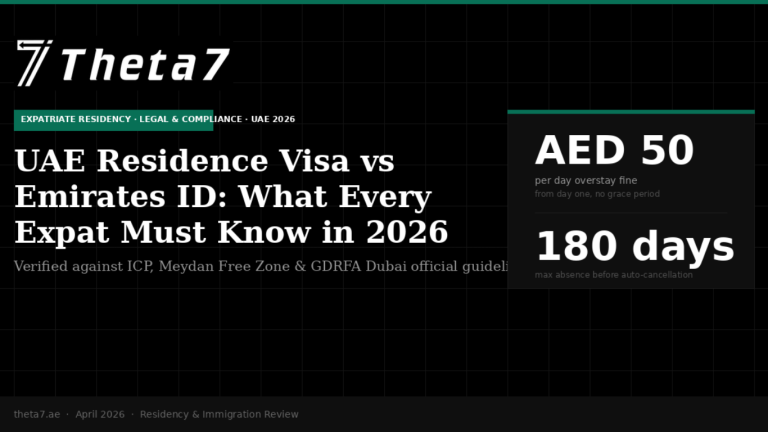
A residence visa has two temporal constraints. The first — the printed expiry date — is widely understood. The second is not, and its consequences are no less severe. Under Federal Decree-Law No. 29 of 2021 on Entry and Residence of Foreigners, a standard UAE residence visa is automatically cancelled if the holder remains outside the UAE for more than 180 consecutive days. There is no warning. The ICP system processes the cancellation automatically once the threshold is crossed.
The 180-day rule applies equally to mainland and free zone visa holders. There is no Meydan or free zone exemption. The absence period begins from the exit date stamped in the passport at any UAE port of departure and resets to zero upon each lawful re-entry into the UAE.
A resident whose visa has been cancelled under this provision cannot re-enter the UAE as a resident. They must apply for a re-entry permit through ICP Smart Services or GDRFA Dubai, provide documented justification for the extended absence, pay financial penalties of approximately AED 100 per 30-day period beyond the limit, and return within 30 days of permit approval.
Exemptions exist for specific categories: residents receiving abroad-approved medical treatment, students at recognised foreign educational institutions, government employees deployed overseas by their employer, and certain investor visa holders. These exemptions are category-specific and must be confirmed with ICP before departure — not invoked after the fact.
UAE Golden Visa holders are entirely exempt from the 180-day rule. They may remain outside the UAE for any duration without triggering automatic cancellation — one of the most material distinctions between a Golden Visa and a standard residence visa for internationally mobile residents.
Visa issues in the UAE don’t stay small. A missed renewal, a delayed application, or exceeding the 180-day limit can quickly turn into fines, cancellation, or re-entry complications.
We take care of everything:
✔ Fast UAE residence visa renewals
✔ Re-entry permits after 180-day absence
✔ Family & dependent visa applications
✔ Golden Visa processing
No confusion. No delays. No costly mistakes.