Why Free Zones Attract E-Commerce Businesses Initially
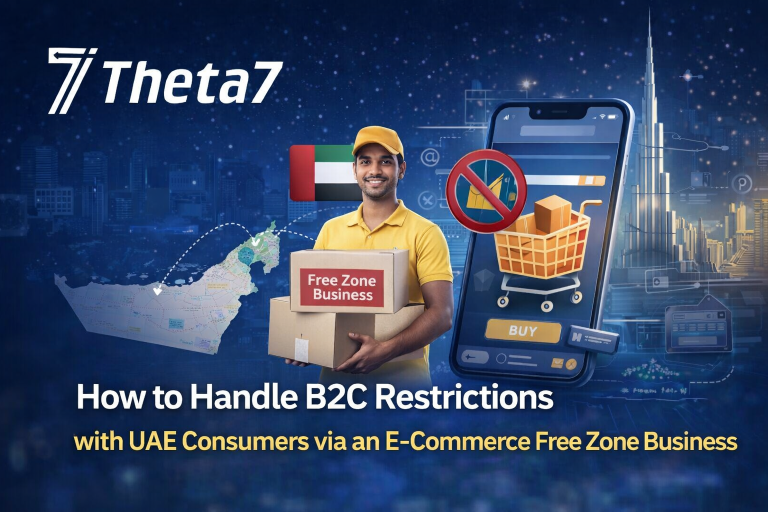
Many Western e-commerce businesses establish their UAE presence in a Free Zone without realising that these structures are designed primarily for logistics, import/export, and international trade, not for selling directly to UAE consumers. Free Zones such as RAKEZ and Ajman Free Zone are well suited to freight forwarding, warehousing, and cross-border fulfilment — but limitations appear as soon as a business targets the UAE consumer market.
The Core Issue: B2C Sales
The issue is B2C sales.
Why Free Zone Companies Cannot Sell Directly to UAE Residents
A Free Zone company cannot lawfully sell directly to UAE residents. This includes operating a UAE-targeted e-commerce website, collecting payments from individuals, issuing consumer invoices, or managing last-mile delivery to local customers. When a Free Zone e-commerce business begins doing any of this, it is operating outside the scope of its licence.
This is why many businesses encounter unexpected problems after launch, including payment gateway refusals, banking compliance queries, VAT complications, and restrictions on local advertising and delivery partners.
The Platform-Based Fulfilment Workaround
There is, however, a commonly used and legitimate workaround — platform-based fulfilment.
How Platform-Based Models Allow B2B Sales
When sales are made through platforms such as Amazon or Noon, and the platform acts as the merchant of record, the transaction is treated as B2B, not B2C. In this structure, the Free Zone company supplies stock to Amazon or Noon, and the platform handles payment collection, invoicing, and delivery to the end consumer. As long as this model is followed strictly, a Free Zone structure can remain appropriate.
The Limits of Platform-Based Fulfilment
That said, this approach has clear limits. The moment a business:
Sells through its own website
Collects payments directly from UAE consumers
Controls local fulfilment or delivery
a UAE Mainland licence becomes mandatory.
When a Mainland Licence Becomes Necessary
In practice, many e-commerce businesses outgrow the Free Zone model quickly. A Mainland company allows unrestricted B2C sales, clean payment processing, compliant VAT registration, local marketing, and direct control over warehousing and fulfilment.
The Compliance Principle for UAE E-Commerce
The principle is straightforward: Free Zones are suitable for logistics and wholesale supply; direct consumer sales require a Mainland licence. For any e-commerce business generating revenue from UAE consumers, moving onshore is not an expansion — it is a compliance requirement.
How Theta7 Supports E-Commerce Businesses
Theta7 advises e-commerce operators on structuring Free Zone logistics correctly, using platform-based B2B models where appropriate, and transitioning to Mainland licences when direct consumer sales are required.
Free Zones support logistics. Mainland licences enable consumer sales. If your revenue comes from UAE customers, the next step is compliance. We can guide the transition.