Most people choose between free zone and mainland based on price alone — and many regret it within the first year.
You've probably read conflicting things. One source says free zones are cheaper and easier. Another says mainland gives you more freedom. Some articles are three years old and don't reflect what's actually changed. And so you're stuck, second-guessing a decision that will shape everything — your operations, your visas, your costs, and your long-term growth.
This article won't tell you which is "better." Because there's no universal answer. What it will do is give you a clear framework to figure out which is better for your specific situation — based on what actually matters in 2026.
Let's start from the beginning.
The UAE operates two distinct commercial environments for businesses. Understanding the structural difference is the foundation of everything else.
Free zones are designated economic areas that operate under their own regulatory framework — separate from the UAE's federal commercial law. There are over 45 of them across the country, each managed by its own authority (DMCC, DIFC, ADGM, IFZA, Meydan, and many others).
When you set up in a free zone, you're essentially establishing your business within a self-contained jurisdiction. You get 100% foreign ownership, tax benefits, and simplified setup — but your ability to trade directly on the UAE mainland is restricted.
A mainland company is licensed by the Department of Economic Development (DED) in the relevant emirate and falls under UAE federal commercial law. It can trade freely anywhere in the UAE and take on government contracts without restrictions.
Since the UAE's landmark 2021 ownership reforms — which eliminated the mandatory 51% local sponsor requirement for most business activities — mainland has become significantly more accessible to foreign investors.
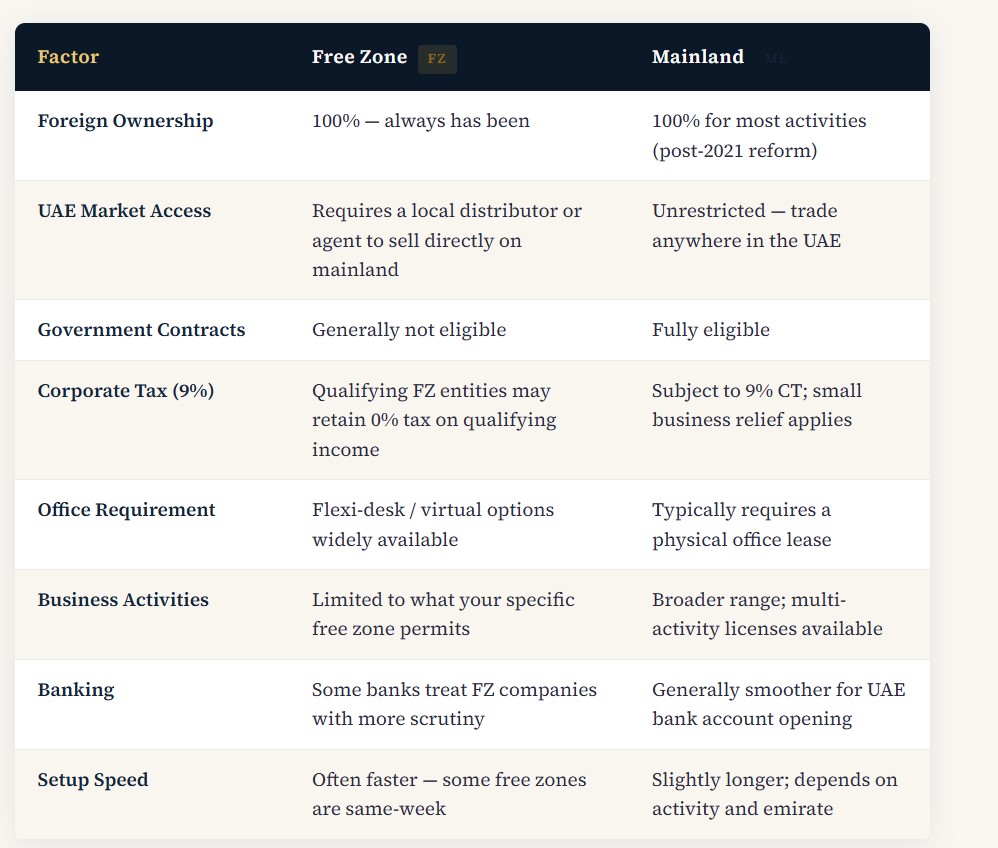
The UAE's Corporate Tax framework — introduced in 2023 and now fully bedded in — has changed how free zone status works for tax planning. Free zone companies can still benefit from a 0% rate, but only on "qualifying income" and only if they meet strict substance requirements. The days of simply registering in a free zone to avoid tax with no real operations are over.
On the mainland side, the continued expansion of 100% foreign ownership eligibility (now covering the vast majority of commercial, consulting, and service activities) has removed the single biggest historical barrier.
Don't assume: Some restricted activities — including certain financial services, legal advisory, and specific professional categories — still require a local partner or UAE national service agent. Always verify your specific activity before deciding.
This is where most setup decisions go wrong. People focus on the license and forget that the visa structure will affect them — and their team — every single year.
Both free zones and mainland companies can sponsor visas for employees and dependents — but the number of visas you're entitled to depends primarily on your office space. No physical office typically means very limited visa eligibility.
As a business owner, you can apply for an investor/partner visa through either structure. The key difference is the ease and cost of adding additional visas as you grow. Mainland companies with a physical lease generally offer more scalable visa capacity.
For founders and investors targeting UAE long-term residency (the 10-year Golden Visa), the pathway exists through both structures — but the qualifying criteria differ. Investment value thresholds, approved activities, and emirate-specific requirements all play a role. This isn't something to figure out after incorporation.
If you're relocating with family, your visa category affects your ability to sponsor dependents. Both setups allow family sponsorship, but your minimum salary threshold and visa type can vary depending on whether you're structured as an investor, partner, or employee of your own company.
Many founders set up a free zone company with a flexi-desk to save money, then discover six months later that they can't get visas for two new hires without upgrading their package — which costs more than a mainland setup would have originally. Plan your visa needs for Year 2 and 3, not just Day 1.
On the surface, free zones often appear cheaper. Some packages start around AED 12,000–18,000 per year. Mainland licenses, particularly in Dubai, typically start higher. But this comparison is incomplete.
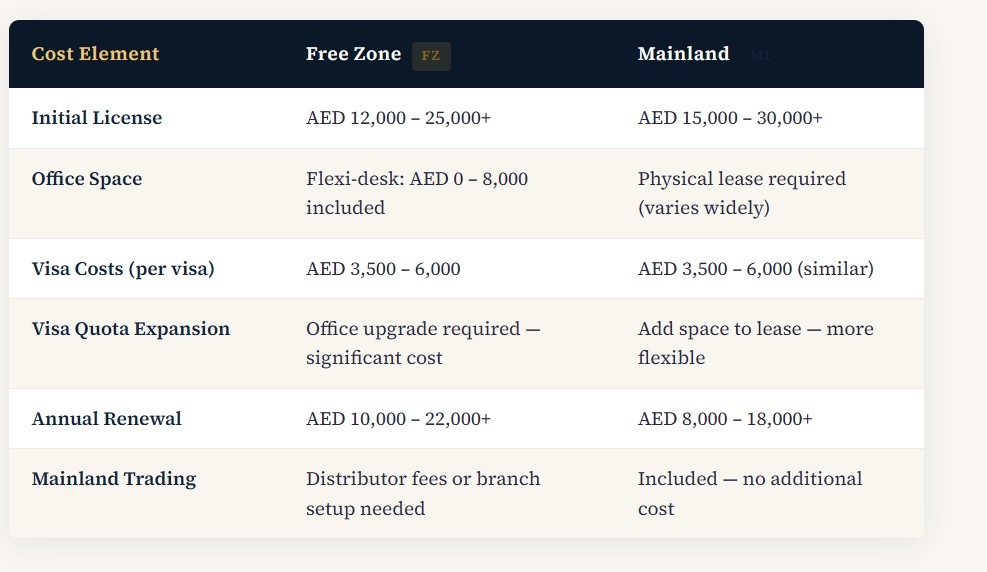
The honest takeaway: for a solo founder or freelancer with no immediate plans to hire or sell on the UAE mainland, a free zone is often genuinely cheaper. For anyone planning to grow a team of three or more, or sell products and services to UAE-based clients directly, the total cost of a mainland setup often becomes comparable — or even lower — within two years.
Stop thinking about this in the abstract. Here's how the decision breaks down by actual business profile.
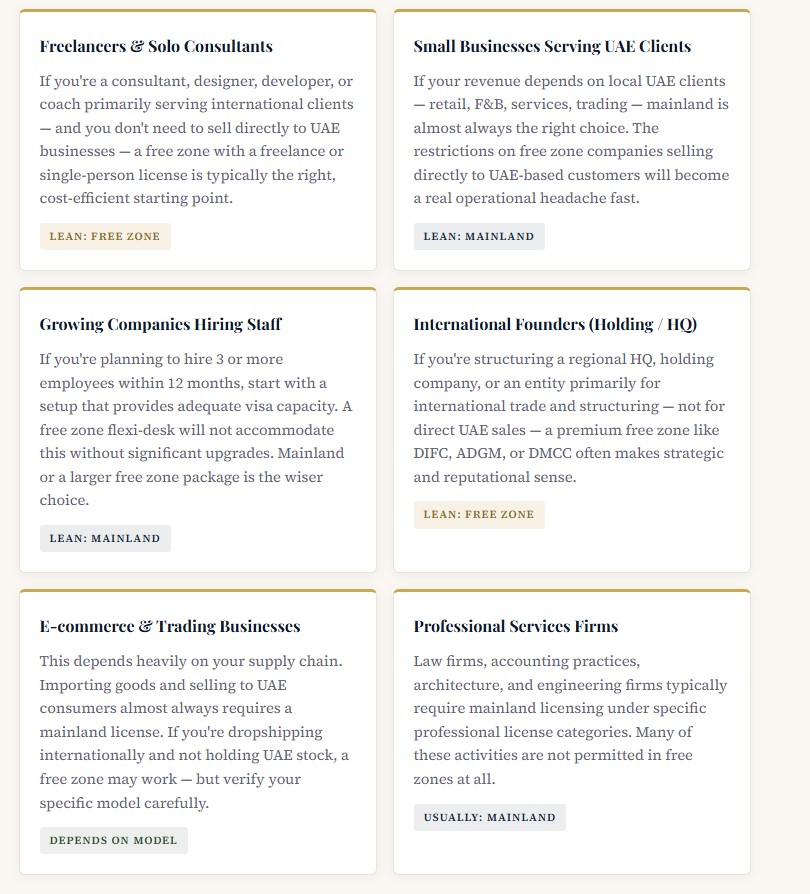
The "It Depends" That Actually Matters
The right answer genuinely depends on: where your clients are, how many people you'll employ, whether you need physical premises, your long-term growth plans, and your tax position. Any consultant who gives you a definitive answer without understanding these factors first is guessing.
A client came to us — an agency founder, originally from Europe — who had set up in a well-known free zone the previous year based on a recommendation from a friend. The setup cost was low: around AED 15,000 all in. It seemed like a smart move.
By month eight, the problems had stacked up. He had two new hires waiting on visas, but his flexi-desk only allowed one additional visa slot. Upgrading the office package to accommodate two more visas would cost AED 22,000 — nearly double his original setup fee. His primary clients were UAE-based companies, but his free zone license restricted direct trading on the mainland, so he was losing deals to competitors who could invoice without a distributor arrangement. And his UAE bank account application had been rejected twice because the bank viewed his free zone setup as insufficiently "rooted" in the UAE.
He re-structured to mainland six months after incorporation. The total cost of that transition — license cancellation, new setup, office lease, re-registration — was AED 38,000.
The original "cheaper" option cost him three times what a mainland setup would have cost from the start.
As the scenario above illustrates, the cheapest setup at incorporation is not always the cheapest option over 24 months. Evaluate costs across your first two to three years, not just day one.
Most founders underestimate how quickly they'll need to sponsor visas — for themselves, for family members, and for staff. Always confirm the visa quota attached to your specific package before committing.
A free zone company is not automatically blocked from all UAE revenue. It can sell to other free zone companies, work with mainland businesses through a properly structured commercial agreement, and invoice internationally without restriction. But direct, unrestricted trade — walking into a UAE-based company and signing a contract — requires either a mainland license or a registered commercial agent. Many founders only discover this restriction after they've lost their first UAE client.
The entity you incorporate today should support the business you plan to run in Year 3, not just the business you're running today. Restructuring a company mid-growth is expensive, time-consuming, and often disruptive to banking relationships and existing contracts.
Not all free zones are equal. They differ on permitted activities, visa quotas, reputation with banks, office requirements, and renewal costs. Choosing a free zone based on the lowest headline price — without checking whether your activity is permitted, or whether the zone has strong banking relationships — is a very common mistake.
There is no one-size-fits-all answer. The right setup depends on your specific activity, growth plan, visa needs, and commercial model. Getting it wrong at the start costs far more than getting it right.
Theta 7 works with founders, investors, and growing companies to make the right structural decision from the outset — not just process paperwork, but think through strategy.