If your business employs people in the Dubai International Financial Centre, workplace savings should form part of your payroll setup from the outset.
Eligible employees must receive employer-funded contributions into the DIFC Employee Workplace Savings plan, known as DEWS, or another qualifying scheme. These obligations apply to small businesses as well as large employers, subject to specific exemptions.
For employers, the practical questions are straightforward: who needs to be enrolled, how much must you contribute, and when must the money be paid?
DEWS is a funded workplace savings arrangement introduced in February 2020 as part of the reform of DIFC end-of-service benefits.
Employers make regular contributions, which are held within an independently governed scheme and invested for employees. Employees can also choose to make additional voluntary contributions through payroll. The compulsory employer contribution is an additional employment cost and must not be deducted from the employee's salary.
Simply recording a gratuity provision in your accounts does not satisfy the monthly funding obligation.
The standard minimum contributions are calculated using the employee's monthly basic wage and length of service:
| Length of service | Minimum employer contribution | Example using AED 10,000 monthly basic wage |
|---|---|---|
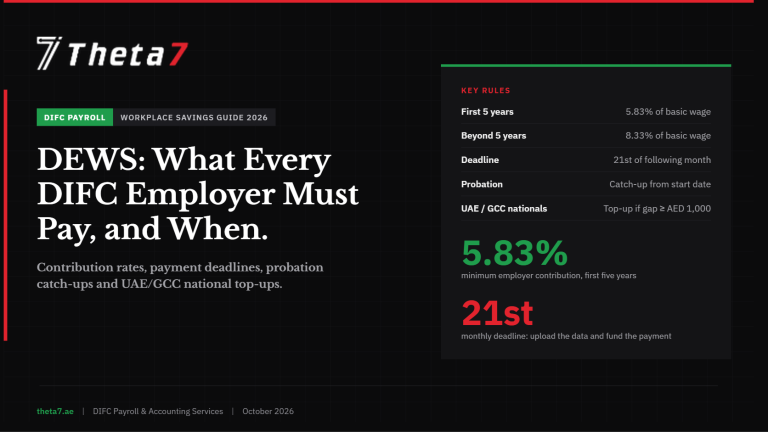
| First five years | 5.83% | AED 583 per month |
| Service beyond five years | 8.33% | AED 833 per month |
Service before the scheme's introduction counts towards the five-year threshold. Payroll must also handle the transition month correctly when an employee reaches that anniversary.
Check the salary split carefully. For this calculation, monthly basic wage cannot be less than 50% of the employee's monthly wage as defined by DIFC law. A contract allocating an unusually small amount to basic salary does not override that minimum.
The monthly deadline is the 21st of the following month. Zurich's operational guidance instructs employers to upload the contribution information and arrange for funds to arrive before the 21st.
For example, September contributions should be uploaded and funded before 21 October. Build in time for bank processing and ensure transfer charges do not reduce the amount received.
Treat the upload and payment as two separate controls: completing one does not complete the other.
Employers may defer contributions during an agreed probation period. However, once employment is confirmed, the contributions must be calculated retrospectively from the employee's original start date.
For example, an employee with an AED 10,000 monthly basic wage who completes three full months of probation would generate a catch-up contribution of AED 1,749, assuming the 5.83% rate applies throughout.
Where contributions were deferred and employment is not confirmed, the probation rules generally mean no core contribution is payable. Contributions already paid remain the employee's entitlement.
For budgeting purposes, allow for the potential catch-up cost each month.
Do not assume that pension registration removes every workplace savings obligation.
Since March 2024, DIFC employers have been required to assess whether eligible UAE and GCC national employees need an additional contribution into a qualifying scheme alongside their pension contributions.
Compare the employer's pension contribution with the core workplace savings contribution that would otherwise apply. Where the monthly shortfall is AED 1,000 or more, the full difference must be contributed. The threshold is not an allowance deducted from the shortfall.
For example, if the relevant core contribution would be AED 3,000 and the employer's pension contribution is AED 1,800, the qualifying-scheme top-up is AED 1,200.
Not automatically. Employees with service before 1 February 2020 may still have a historic gratuity entitlement for which the employer remains responsible.
An eligible transfer into DEWS with the employee's written consent can discharge the corresponding liability. Employers should therefore review historic gratuity separately from ongoing monthly contributions.
A reliable monthly process should cover:
For a new DIFC business, include these steps in the first payroll implementation. For an established employer, a reconciliation can identify missing contributions or calculation errors before they accumulate.
Theta 7 can help you bring workplace savings into your payroll and bookkeeping processes, from reviewing contribution calculations to reconciling payments and tracking historic gratuity balances.
Setting up in the DIFC or reviewing your existing payroll? Contact Theta 7 to discuss your workplace savings obligations and ongoing payroll support.