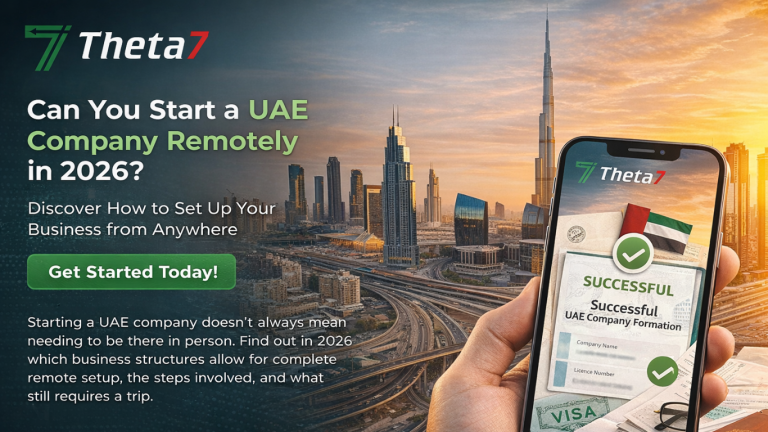
Many people think you must be physically in Dubai to start a company — but that's not always true.
If you've been researching UAE business setup online, you've probably come across conflicting information. Some sources say everything can be done remotely. Others insist a visit is mandatory. The reality, as with most things in business, sits somewhere in between.
This article cuts through the noise and gives you a clear, honest picture of what's actually possible in 2026 — what you can do from your home country, what still requires a trip, and how to plan your setup without unnecessary surprises.
The short answer is: yes — but it depends on the structure you choose and the specific requirements of the free zone or mainland authority involved.
Remote company formation in the UAE has become significantly more accessible over the past few years. Many free zones now offer fully digital onboarding, e-signature capabilities, and document submission portals that make it possible to incorporate without stepping on a plane.
However, "remote setup" doesn't mean "no physical presence ever." There are specific steps — particularly those tied to residency visas — where a visit to the UAE becomes unavoidable. Knowing the difference upfront is what separates a smooth setup from a frustrating one.
The key is understanding which business structure aligns with your goals and your ability (or willingness) to travel.
Not all UAE company types are created equal when it comes to remote incorporation. Here's how the main options compare.
Free zones are the most remote-friendly option available in 2026. Many of the UAE's 40-plus free zones — including IFZA, SHAMS, Meydan, and Fujairah Creative City — have invested heavily in digital infrastructure.
With a free zone setup, you can typically:
Free zones are ideal for consultants, digital businesses, trading companies, and service providers who don't need a physical presence inside the UAE market.
The trade-off is that free zone companies cannot directly trade with UAE mainland clients without certain arrangements. For many international entrepreneurs, this is not a concern — but it's worth knowing upfront.
Mainland company formation through the Department of Economic Development (DED) is more nuanced when it comes to remote setup.
Some stages — particularly initial applications and document submission — can be handled remotely through registered agents and consultants. However, mainland setup tends to involve more government touchpoints, and certain approvals may require a physical presence or a local service agent depending on your business activity.
If your primary goal is to trade within the UAE domestic market, mainland is the right structure. But if you want maximum flexibility for remote incorporation, a free zone is generally the simpler path.
UAE offshore structures — such as those registered in Ras Al Khaimah (RAKEZ) or Jebel Ali (JAFZA) — are among the most remotely accessible of all.
Offshore companies are not permitted to conduct business inside the UAE, but they are widely used for:
The entire offshore setup process can typically be completed without visiting the UAE, making it a popular option for international investors who need a UAE-registered entity without operational requirements on the ground.
Understanding the process helps you prepare properly and avoid unnecessary delays. Here is a typical remote setup journey for a UAE free zone company.
Before any paperwork begins, you'll work with a business setup consultant to determine the right free zone, licence type, and activity codes for your business. This stage is entirely remote and should never be rushed — the decisions made here affect everything that follows.
You'll be required to submit a standard set of documents, which typically includes:
Documents are submitted digitally through the free zone's portal or via your consultant. Certified or notarised copies may be required depending on the authority.
Once your application is approved and payment is made, your trade licence is issued. Most free zones deliver the licence digitally, and a physical copy can be couriered to your address abroad.
This stage is fully remote and typically takes between 3 and 10 working days depending on the free zone.
This is where remote setup hits its first real boundary. If you intend to apply for a UAE residency visa under your new company, a physical visit to the UAE is required for:
If you do not need a UAE residency visa — for example, if you are setting up purely for international operations or an offshore structure — this step does not apply.
Being honest about this section is important. Here is what typically cannot be completed remotely in 2026.
If you are applying for a UAE residency visa, you must visit the UAE in person to complete biometric registration at an EIDRA (Emirates ID and Residency Authority) centre. This cannot be done remotely or through a representative.
A medical test at an approved clinic in the UAE is a mandatory part of the visa process. This is a non-negotiable requirement and applies to all nationalities.
This is one of the most frequently misunderstood aspects of UAE company setup. While some digital and neobank options allow remote account opening, most traditional UAE banks — including Emirates NBD, Mashreq, and Abu Dhabi Commercial Bank — require the account signatories to be physically present for at least one meeting.
Remote bank account opening is possible in some cases, but success rates are lower and the process is longer. Managing expectations here is critical.
Certain documents — particularly for mainland companies or regulated activities — may need to be notarised in your home country and attested through official channels before they are accepted. Your consultant should clarify this early.
The internet is full of oversimplified claims about UAE company formation. Here are the ones we encounter most often.
Incorporation itself often can. But the broader ecosystem — visas, banking, compliance — still has offline requirements that have not been fully digitised. Anyone telling you otherwise is oversimplifying.
If your company setup includes a residency visa, you will need to visit. Planning for one short trip — typically three to five days — is a realistic expectation for most remote clients who want full residency benefits.
Processing times vary. Free zones advertise fast turnaround times, and many do deliver quickly, but bank approvals, government clearances, and document verification can all create delays. Building a realistic timeline into your planning is essential.
Beyond the obvious requirements, there are subtler challenges that catch international clients off guard.
Opening a UAE corporate bank account remotely remains one of the most difficult aspects of the process in 2026. Banks conduct thorough compliance checks, and without a face-to-face meeting, many applications stall or are declined. Working with a consultant who has established banking relationships can make a significant difference.
UAE free zones and mainland authorities are increasingly rigorous about Know Your Customer (KYC) requirements. Documents must be current, clearly legible, and sometimes formally attested. Incomplete or inconsistent documentation is the single biggest cause of delays in remote applications.
Managing a company setup across multiple time zones requires patience and clear communication. Delays in responding to document requests or queries from government authorities can extend timelines significantly. Having a local consultant acting on your behalf resolves much of this friction.
Setting up the company is only the beginning. Annual licence renewals, VAT registration (if applicable), accounting requirements, and visa renewals all continue after incorporation. Remote clients need to plan for ongoing compliance management, not just the initial setup.
Consider a client based in the United Kingdom — a digital marketing consultant who wanted to formalise her business under a UAE free zone structure for international invoicing purposes.
She had no immediate plans to relocate to the UAE and did not require a residency visa. Her goal was simply a legitimate UAE trade licence she could use to invoice global clients.
What went smoothly:
What required more planning:
The entire incorporation was completed without a single flight. But it required proper guidance, realistic expectations, and a consultant managing the process on her behalf.
Remote setup is genuinely accessible in 2026 — but it works best when your expectations align with the reality of the process.
If you are setting up a free zone company for international business and do not immediately require a UAE residency visa, a fully remote setup is highly achievable. If you need a residency visa, plan for one trip. If you need a traditional UAE bank account, start that process early and seek expert guidance.
The entrepreneurs who experience the smoothest remote setups are those who invest time in understanding the process, prepare their documents carefully, and work with a consultant who manages the moving parts on their behalf.
Remote company formation in the UAE is not only possible — for the right type of business, it's practical, affordable, and surprisingly straightforward.
But the details matter. The wrong free zone, a missing document, or a misunderstood requirement can turn a two-week process into a two-month frustration.
At Theta 7, we specialise in guiding international entrepreneurs through UAE company setup from wherever they are in the world. We handle the paperwork, liaise with the free zone authorities, manage your document submissions, and keep you informed at every step — without you needing to be in the room.
Whether you're a freelancer in Europe, an investor in Asia, or an entrepreneur in the Americas, we'll give you a clear, honest assessment of what's possible for your specific situation — and a practical roadmap to get there.
Ready to take the next step? Contact Theta 7 today for a remote consultation and find out exactly how to start your UAE company from abroad in 2026