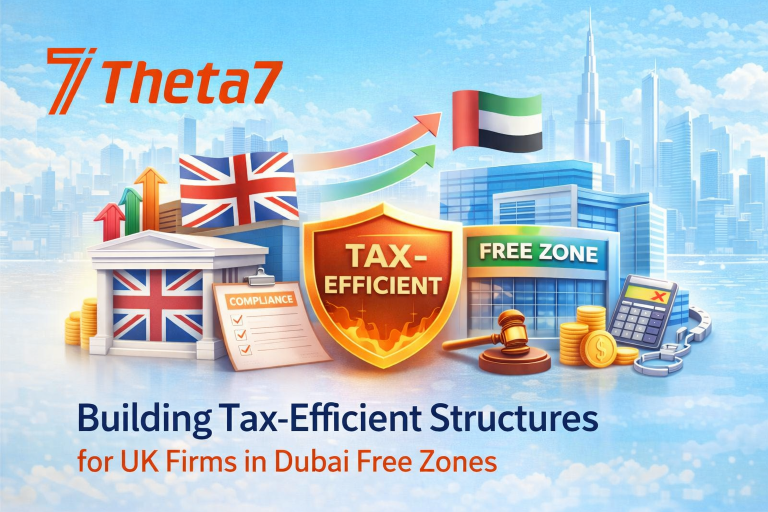
Expanding into the UAE is no longer just about speed or cost—it’s about precision, compliance, and long-term value. Building Tax-Efficient Structures for UK Firms in Dubai Free Zones requires far more than simply registering a company and opening a bank account. For UK business owners, directors, and shareholders, the real advantage lies in how the structure is designed from day one.
At Theta 7, we believe in one principle: don’t just register a company—build a foundation for growth. That foundation must align with both UK tax rules and UAE regulatory frameworks, ensuring genuine tax efficiency without risking future disputes, penalties, or restructuring costs.
Many UK firms are drawn to Dubai by headlines promising “0% tax” and “48-hour company formation.” While these claims may be technically accurate, they often hide serious compliance gaps. A rushed setup may overlook:
UAE Economic Substance Regulations (ESR)
UAE Corporate Tax qualification rules
UK Controlled Foreign Company (CFC) exposure
HMRC scrutiny over artificial profit shifting
The result? A structure that looks efficient on paper but collapses under audit.
A properly designed UAE structure acts as a strategic framework. It supports:
Regulatory compliance in both jurisdictions
Operational substance and scalability
Clean audits and transparent reporting
Future exits, investment, or group restructuring
This is where Building Tax-Efficient Structures for UK Firms in Dubai Free Zones becomes a strategic exercise—not an administrative one.
Dubai Free Zones are designated economic areas offering incentives to foreign investors. Each Free Zone has its own authority, licensing rules, and permitted activities, but all operate under UAE federal law.
UK individuals or companies can fully own UAE Free Zone entities without local partners.
Profits, dividends, and capital can be repatriated without restrictions, subject to compliance and banking rules.
Since June 2023, the UAE has implemented a 9% federal corporate tax. However, Free Zone companies may still benefit from a 0% rate if they qualify as a Qualifying Free Zone Person (QFZP).
Key conditions include:
Carrying out qualifying activities
Maintaining adequate substance in the UAE
Complying with transfer pricing rules
Filing corporate tax returns annually
Not all income qualifies for the 0% rate. Non-qualifying income—such as certain mainland transactions or passive income—may be taxed at 9%.
Incorrect invoicing between UK and UAE entities
Mixing qualifying and non-qualifying activities
Lack of documented substance
UK-owned Free Zone companies must demonstrate:
Adequate employees in the UAE
Physical office premises
Decision-making occurring locally
Substance is not only a UAE issue. HMRC increasingly examines whether overseas profits reflect genuine economic activity. Proper ESR compliance strengthens your UK tax position.
For UK-resident individuals, structuring must consider:
UK income tax on dividends
Remittance basis (if applicable)
Double tax treaty positioning
When a UK Ltd owns a UAE Free Zone company, issues include:
CFC rules
Transfer pricing
Management and control
Hybrid models—using holding entities or IP companies—can provide flexibility while remaining compliant when properly designed.
UK CFC rules may tax profits of overseas subsidiaries if:
The UK parent controls the entity
Profits are artificially diverted
Through genuine substance, arm’s length pricing, and proper governance, exposure can often be reduced or eliminated.
Free Zone companies must maintain:
IFRS-compliant accounts
Annual audits (where required)
Corporate tax filings
Well-structured UAE entities integrate smoothly into UK group reporting, avoiding last-minute adjustments and red flags.
Profit extraction must be structured carefully to avoid:
Withholding tax issues
Transfer pricing disputes
UK reclassification risks
A clean structure increases valuation and reduces friction during:
Trade sales
Private equity investment
International expansion
Banks, investors, and regulators all look for real businesses, not shell entities. Substance equals credibility.
Tax laws evolve. Structures built with foresight remain compliant without constant restructuring.
Unlike traditional formation agents, Theta7.ae prioritizes tax position first, license second. Our UAE-based team understands both UK tax principles and UAE regulatory expectations.
UK consultancy group restructures UAE operations → ~25% effective tax reduction
E-commerce founder avoids CFC exposure → clean HMRC position
Professional services firm prepares exit → audit-ready structure
These outcomes are not loopholes—they are the result of compliant design.
Yes, but only if they meet qualifying conditions under UAE Corporate Tax law.
HMRC focuses on substance and intent. Properly structured entities are defensible.
In most cases, yes—to satisfy economic substance requirements.
Some are, but many require annual audited financial statements.
Repatriation is allowed, but UK tax treatment depends on structure and shareholder status.
Because fixing a bad structure later is far more expensive than doing it right initially.
Building Tax-Efficient Structures for UK Firms in Dubai Free Zones is not about shortcuts—it’s about strategy. The right structure protects your tax position, supports growth, and stands up to scrutiny on both sides of the border.
At Theta 7, our UAE-based team combines cross-border tax insight with practical implementation. We don’t sell licenses—we build compliant, scalable foundations for international success.
If you want to build the right structure rather than repair the wrong one, reach out today before you incorporate—or before HMRC or regulators ask the questions first.