Urgent · Conflict Impact · Visa Status · Golden Visa · UAE 2026
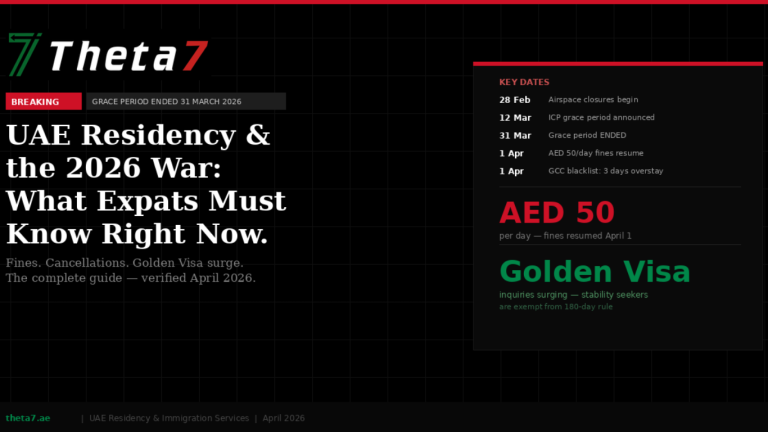
The grace period has ended. Fines have resumed. Thousands of expats are still navigating the fallout. This is the complete, verified picture — what happened, what the rules are today, and exactly what you should do next.
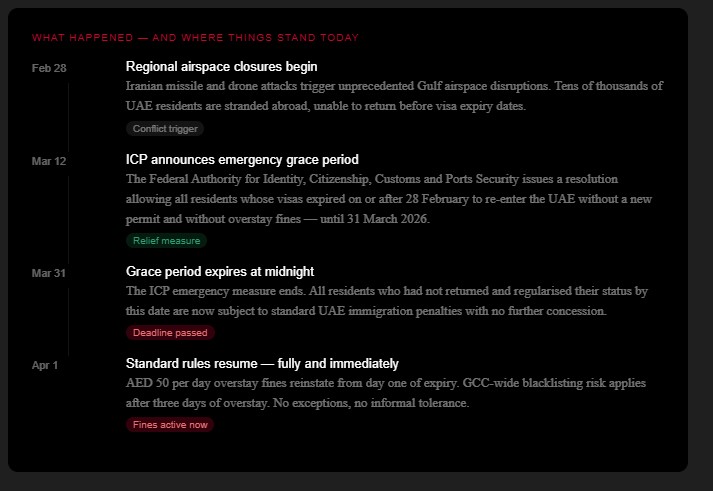
The 2026 Middle East conflict produced an immigration situation the UAE had never formally encountered at scale: tens of thousands of resident visa holders stranded abroad simultaneously, unable to return by their expiry dates through no fault of their own. The ICP's response — a one-month emergency grace period — was swift and broadly welcomed. For those who used it, the crisis passed with manageable disruption. For those who did not, or who are still abroad with unresolved status, the situation as of April 2026 is significantly more complex.
This article addresses where things stand now — for those still outside the UAE, for those who returned during the grace period and still need to complete their renewal, for families whose dependent visas were caught in the disruption, and for anyone reconsidering whether their current visa category provides adequate protection if a similar situation were to arise again.
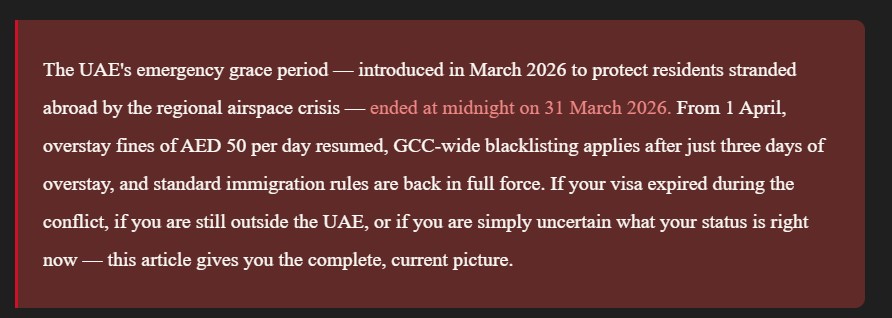
If your UAE residence visa expired during the conflict period and you did not return before 31 March 2026, you are now in an overstay situation under standard UAE immigration rules. The emergency measure no longer applies. This does not mean your residency is permanently lost — but it does mean the resolution pathway is now more involved than it was during the grace period.
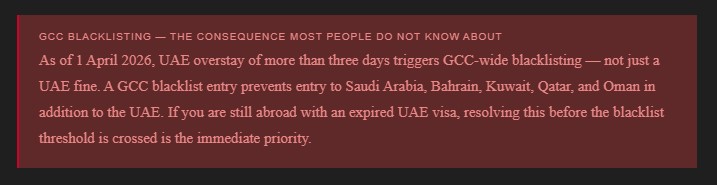
The formal resolution pathway for residents outside the UAE with expired visas is a re-entry permit application through the ICP Smart Services portal at smartservices.icp.gov.ae or through GDRFA Dubai at gdrfad.gov.ae. The application requires a documented reason for the extended absence — the regional conflict and airspace disruptions of February–March 2026 constitute a recognised exceptional circumstance, and applications citing these reasons are being processed. Financial penalties for the overstay period apply and must be settled as part of the re-entry process. Upon permit approval, the return to the UAE must be made within 30 days.
For residents whose visa was cancelled specifically because of the 180-day absence rule rather than simple expiry, the process is the same — but the documentation required to support the application is more detailed. Professional guidance at this stage is not optional. The difference between a well-prepared re-entry application and an incomplete one is the difference between a resolution in days and one that drags on for weeks while penalties continue to accrue.
On arrival during the grace period, immigration officers stamped a 30-day entry permit, during which residents were required to apply for visa renewal or transfer to a new employer. If you returned before 31 March and received this stamp, your 30-day regularisation window may already be running — or may have already expired depending on when you arrived.
If your 30-day entry stamp is still active, the renewal process must be initiated immediately. The standard renewal process applies: medical fitness test at a DHA-approved centre, Emirates ID typing form submission, and portal application through your sponsor. Authorities urged companies to initiate electronic renewal filings in advance to avoid bottlenecks once workers returned. If your employer or sponsor has not yet initiated the process, contact them today — not tomorrow.

The conflict of 2026 prompted a wave of questions that most UAE residents had not previously asked seriously: is the UAE politically stable enough to be a long-term base? What happens to my residency and my family if another crisis closes the airspace? Should I be looking at other options?
The honest answer, supported by observable data, is nuanced. Roughly one in eight of the UAE's 240,000 British residents reportedly left after the regional conflict began. At the same time, Golden Visa inquiries surged sharply following the airspace disruptions, with applicants citing UAE political stability, advanced healthcare, and investor-friendly tax policies as the primary reasons for pursuing long-term residency — despite the ongoing regional tensions. These two data points are not contradictory. They describe two different responses to the same event: those whose residency framework gave them insufficient protection left, and those seeking stronger long-term security applied for a more robust visa category.
The UAE's response to the crisis — a formal ICP grace period, the suspension of 180-day cancellations during the disruption period, and active communication through official channels — demonstrated institutional competence in managing an exceptional situation. The framework held. What was exposed was not a flaw in the UAE system but a gap in the protection that standard residence visas offer compared to Golden Visa status, particularly around the 180-day rule and family security provisions.
Visa advisory agencies across the UAE report a sharp rise in Golden Visa inquiries following the missile attacks, with property-related Golden Visas remaining the most popular option as homeowners move quickly to complete applications rather than delay them. The reasons are practical, not merely psychological.
A standard UAE residence visa holder who was abroad during the February–March 2026 disruption faced potential automatic cancellation under the 180-day rule, overstay fines, GCC blacklisting risk, a 30-day dependent visa clock for their family, and a re-entry permit process. A Golden Visa holder in the identical situation faced none of these — because the 180-day absence rule does not apply to Golden Visa holders, their dependents are independently protected, and their grace period in the event of cancellation is 180 days rather than 30. The crisis made the difference concrete and visible in a way that no amount of informational content previously had.
Real estate investors with property at AED 2 million or above. Business owners and entrepreneurs meeting investment thresholds. Skilled professionals earning AED 30,000 basic salary per month or above. Scientists and specialists in designated fields. Outstanding students and graduates. Digital creators and environmental innovators under the expanded 2025 categories. Salary-based applications are growing fastest, with consultants noting rising inquiries from mid-level managers earning over AED 30,000 per month who already hold standard work visas but seek long-term flexibility. Many qualify without knowing it. An assessment takes a single conversation.
The UAE cancelled the residency visas of Iranian nationals outside the country during the conflict period, leaving a number stranded abroad. Iranian residents discovered their visas had been revoked before returning, preventing re-entry — while non-Iranian family members of those individuals were still able to return. Due to the 2026 Iran war, citizens of Iran are currently barred from entering or transiting the UAE.
For affected Iranian nationals and mixed-nationality families where the primary visa holder is Iranian, the situation requires direct, professional guidance specific to individual circumstances. The standard re-entry permit pathway does not apply in the same way, and the options available vary significantly depending on nationality, visa category, and family composition. This is not a situation to navigate through a portal alone.
Separately from the conflict-related measures, the UAE implemented a significant overhaul of its visa framework in late 2025 and early 2026. ICP announced four new purpose-built visit visa categories and eleven key updates covering expanded multi-entry visa options, new sponsorship salary requirements, and broader long-term residency paths.
Visitors can now extend most 30-day or 60-day tourist and business visit visas fully online through the ICP portal without exiting the country, and those on visit or job-seeker visas can convert to employment residency from within the UAE without leaving — a significant change that removes weeks of mobilisation delay for employers and new hires alike.
Sponsorship income thresholds are now tiered based on the relationship being sponsored, and all applicants should expect to provide passport copy, passport-size photo, passport external cover copy, and accommodation proof as standard documentation. These changes apply across all visa categories and are in full effect as of April 2026.
The 2026 conflict tested the UAE's immigration framework at scale and the system responded with competence — a formal grace period, institutional communication, and a structured resolution pathway. The UAE's fundamental appeal — zero income tax, world-class infrastructure, a 90% expatriate population, and political neutrality within a volatile region — remains intact. The residents who left were not leaving because the UAE failed them. Most were leaving because their residency framework did not give them adequate protection when exceptional circumstances arose.
The lesson of the 2026 crisis is not that the UAE is less safe. It is that a standard residence visa, tied to a sponsor and subject to the 180-day absence rule, is not the same thing as long-term residency security. For those with families, assets, and lives built in the UAE, the question the crisis raised is a straightforward one: is the visa category you are on the one that reflects the seriousness of your commitment to being here?
The post-grace-period window is the most urgent residency situation thousands of UAE expats have ever faced. Theta7 is actively managing conflict-related visa resolutions, post-grace renewal completions, and Golden Visa assessments for residents who recognise that a standard visa no longer provides the protection their life in the UAE requires. We respond the same day.
Emergency re-entry permit applications for residents still outside the UAE
Post-grace-period renewal completion — before your 30-day entry stamp expires
Overstay fine resolution and GCC blacklist prevention
Golden Visa eligibility assessment — all 2026 categories
Family and dependent visa resolution — 30-day window management
Standard visa renewals — all sponsor types, fully managed